
Children spend a huge portion of their lives on the field, in the classroom, and in local sports facilities. At the All-in Foundation, that is precisely why we’ve always put so much energy into the adults who surround the young people there: teachers, coaches, instructors, and leadership. Yet carers are also a central pillar of a child’s life. How a mum, dad, grandparent or guardian processes their own stress, sits with their emotions, and talks (or doesn’t talk) about what’s going on for them shapes, more than almost anything else, how their child turns up to school or training the next morning.
The usual toolkit for reaching parents, like website updates, parent evenings, or experiential workshops, is a more than decent starting point to build a connection with carers at school or the club. But it tends to stay on the surface. If we truly want to shift something and support them, we need to meet carers where they already are: in schools and sports clubs, and offer them something with real depth: group analytic therapy.
Why Schools and Sports Clubs Offer an Ideal Setting
Think about it for a second. Schools and sports clubs are natural hubs of community. They are places where carers drop off their children, cheer from the sidelines and chat with other families in the car park. Running peer reflection groups in these familiar, low-pressure spaces removes a huge amount of stigma that usually clings to anything labelled “mental health support”. It reframes support not as a sign of crisis, but as an accessible, everyday part of community care.
And the effects don’t stay contained to the carer. Children are remarkably good at picking up on the emotional weather at home, even when nobody’s said a word about it. A study of migrant children in China found that parental emotion regulation shaped children’s resilience not just directly, but through a chain of effects: better emotional regulation in parents fed into stronger self-efficacy and hope in their children, which in turn built resilience. Give carers somewhere to process the pressures of modern parenting, and something interesting tends to happen: the instinct to hover, to steer, to manage every outcome, gradually loosens into something closer to trust. That loosening matters. When parental anxiety eases off, children get the room they need to build their own sense of competence, motivation, and staying power, on the pitch and in the classroom alike.
At the same time, when carers engage in self-reflection alongside teachers and coaches, it seamlessly aligns the values nurtured at home with those practised on the field and in the classroom.
What Happens in the Group?
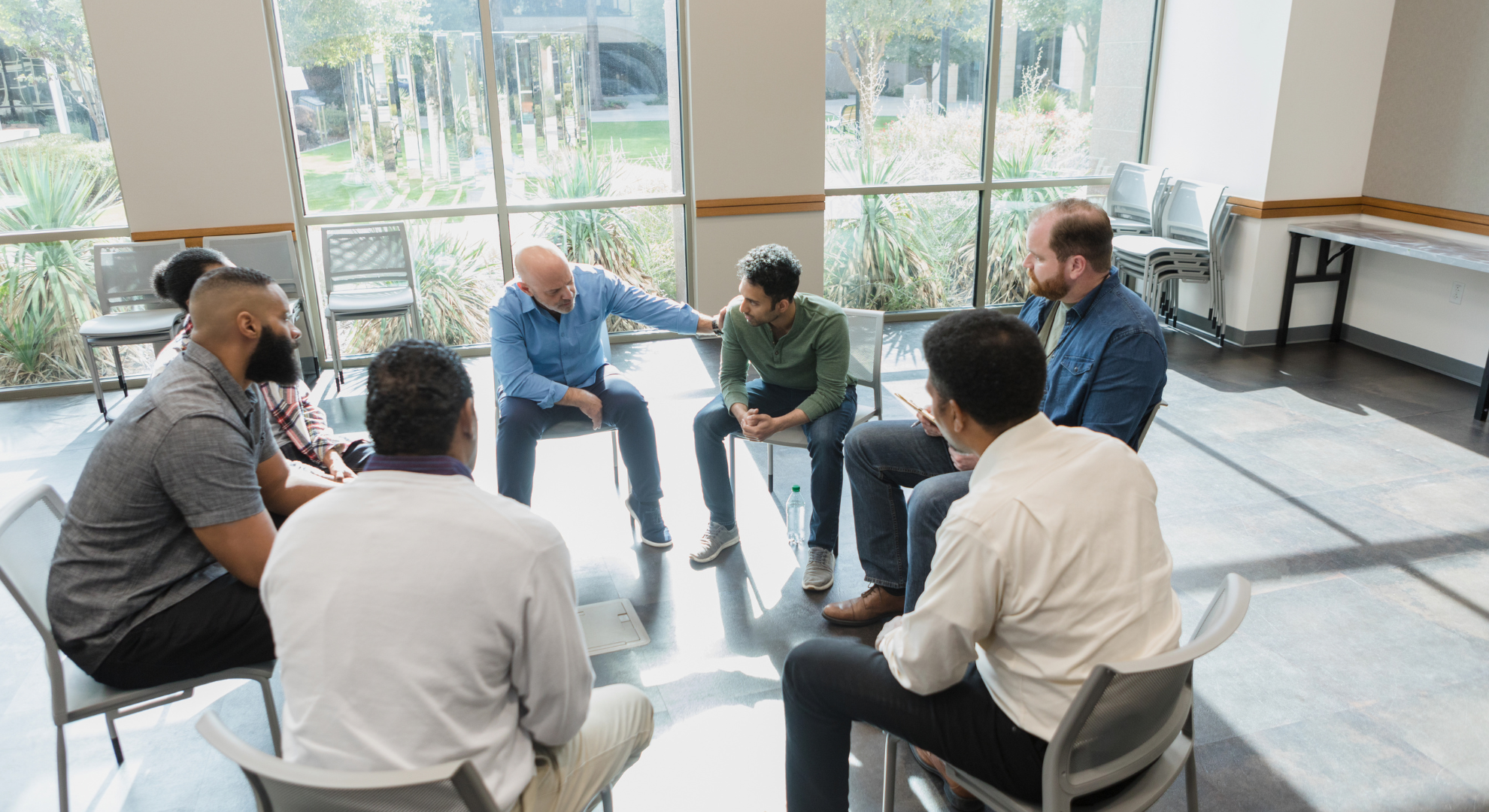
This model draws on Group Analysis, developed by S. H. Foulkes, and it flips the usual therapy script on its head. There’s no expert at the front dispensing parenting advice. Instead, the group itself becomes the engine of insight, carers talking to carers, noticing patterns, offering each other something a professional simply can’t: recognition.
Parenting in today’s world can feel lonely, even while being surrounded by others. Many carers are quietly carrying stress, self-doubt, or the fear that they are falling short. The moment someone else in the circle says “actually, I feel exactly the same”, that’s universality, one of the oldest and most reliable mechanisms in group therapy, and it brings real, immediate relief. This isn’t just theory: research on group-based therapy identifies group cohesion: the intimacy, reciprocity and emotional openness shared among members, as central to how these groups produce change. And burnout responds to it too: a randomised controlled trial of group interventions for mothers found that structured group support meaningfully reduced parental burnout, with effects still holding six months later.
Groups also function as a kind of compassionate mirror. As carers talk through the ordinary friction of daily life, they often start to notice how their own upbringing is quietly steering their parenting style now. This connects to something attachment researchers have been circling for years: a carer’s capacity to reflect on their own inner world and their child’s, what’s known as reflective functioning, has consistently emerged as a predictor of secure attachment, a link first established in infancy and since shown to extend to parents of older, school-aged children too. The theory goes that reflective functioning bridges the gap between how a parent themselves was cared for and how securely their own child attaches, largely because it shapes how responsive a carer is to their child’s emotional signals. Hearing other carers, from entirely different walks of life, talk through how they handle conflict has a quiet but powerful effect: rigid assumptions about “the right way” to parent soften, and difference starts to feel less like a threat and more like a resource.
Homogeneous vs. Heterogeneous Settings
While mixed (heterogeneous) groups offer a rich diversity of perspectives, there is immense value in hosting homogeneous groups tailored to specific life situations:
- Fathers’ Groups: Fathers often face unique societal expectations or internal barriers around vulnerability. A group specifically for dads creates a psychological safety net where they can drop the armour, discuss emotional parenting, and explore what meaningful male involvement looks like. Recent sociological studies demonstrate that peer-led male reflection groups significantly increase emotional engagement and foster calmer communication in the home.
- New Inhabitants & Cultural Bridging: Arriving in a new country or community can leave a carer feeling adrift, even if the move itself was a good one. Running sessions in a carer’s native language, shaped by familiar customs, creates an immediate sense of psychological safety, the kind that lets people say what they actually mean, rather than what translates easily. Done well, these sessions can gently weave native traditions together with local customs, so the room itself becomes a bridge between the life someone left and the one they’re building. Adjusting the physical space- seating, rituals, small welcoming gestures- to reflect participants’ backgrounds isn’t a nice-to-have; it’s often what makes the difference between a group people show up to and one they quietly avoid.
Despite the different doors people walk in through, every one of these groups eventually arrives at the same place: a shared identity as a carer. A single mother, a newly arrived father, a long-time local business owner, different lives entirely, but underneath it, the same wish for their child to be safe, happy, and to have a decent shot at the future. That recognition tends to build a form of community cohesion that outlasts the sessions themselves.
Practical Structure: Rhythm, Stability, and Leadership
None of this works without a stable, predictable frame. Reflection needs safety, and safety needs structure.
- Ideal size & setup: A group of 8 to 9 participants provides the optimal balance; large enough for diverse perspectives, yet small enough that nobody gets lost. A semi-open group structure accommodates the natural rhythm of life, allowing new carers to join as others complete their journey.
- Frequency: Groups meet every 4 to 6 weeks for 1.5 to 2 hours. This interval provides participants with enough space to integrate new insights into daily family life while maintaining strong group connection over long periods or even years.
- A fixed, adapted space: Groups meet in the same room for their entire duration, as physical predictability creates an essential sense of safety and “protected space”. The atmosphere, from seating arrangements to rituals, is intentionally tailored to honour the cultural backgrounds and preferences of the group members.
- Paired group leaders (Co-facilitators): Rather than a single leader, groups should be co-facilitated by two leaders. They act not as experts lecturing the group, but as “conductors” who hold the boundaries, monitor group safety, keep time, and help restart communication stumbles.
Required Resources and Strategic Partnerships
Getting this off the ground doesn’t require reinventing anything from scratch. A few foundational pieces are needed:
- People: Two qualified group analysts, systemic therapists, or trained community counsellors per group.
- Space: A quiet, private room reserved consistently on school or sports club premises, equipped with comfortable seating and something warm to drink, small things that signal: “ÿou’re welcome here”.
- Buy-in: Briefing coaches, teachers, and school leadership so they understand how to introduce families to group support in a warm, welcoming way, never as a disciplinary or clinical referral
Schools and sports clubs don’t need to build or fund this on their own. Partnering with municipal youth services or preventive health networks can unlock funding, bring in certified co-facilitators, and establish seamless referral pathways if a family ever desires specialised individual care. It’s a way of linking informal, everyday community care with the more formal services sitting behind it.
Bringing Carers on Board
Introducing group reflection to carers works best when framed with warmth, respect, and accessibility:
- Positioning the initiative as a space for growth and community support means skipping anything that sounds like a formal parenting class. Naming it a Carer Reflection Lounge or a Peer Support Circle frames it around navigating the shared journey of school and sport life together rather than fixing a problem.
- Reaching carers through personal, trusted invitations makes a substantial difference, as a quiet word from a favourite coach or familiar teacher lowers resistance far better than any flyer ever could.
- Aligning the group with existing schedules by hosting sessions directly alongside training or school club hours ensures childcare is already sorted, meaning joining in asks nothing extra of a carer’s week.
Finally, engaging bilingual community champions, especially for new inhabitant groups, allows respected, bilingual parents to explain the idea in someone’s own language and cultural frame, making a genuine difference in who actually walks through the door.
Give carers a consistent, safe space to sit with their own inner world alongside people who genuinely understand, and something shifts. Parenting stops being a task carried alone behind closed doors, and starts becoming what it probably always should have been: a shared undertaking, built on community, growth, and a resilience that belongs to everyone involved, not just the parent in the room.
Sources referenced: Boughton & Lumley (2011), Journal of Attachment; migrant parental emotion regulation study, Current Psychology (2023); Borelli et al., reflective functioning in parents of school-aged children, American Journal of Orthopsychiatry; parental reflective functioning review, Child Psychiatry & Human Development (2024); fathers’ peer support studies including Journal of Child and Family Studies (2019) and the Working Out Dads RCT, BMC Psychiatry (2022); group cohesion in group-based therapy, Psycho-Oncology (2019); parental burnout group intervention RCT, Journal of Child and Family Studies (2025).